
Balice in 2012
The control tower and terminal observation deck have modelled interiors. Airport buildings, aircraft, trees and people use custom artwork.
EPKK · Kraków, Poland Map
Microsoft Flight Simulator 2004
Approach Balice from the hills west of Kraków, with the historic city and its landmarks beyond the airport.
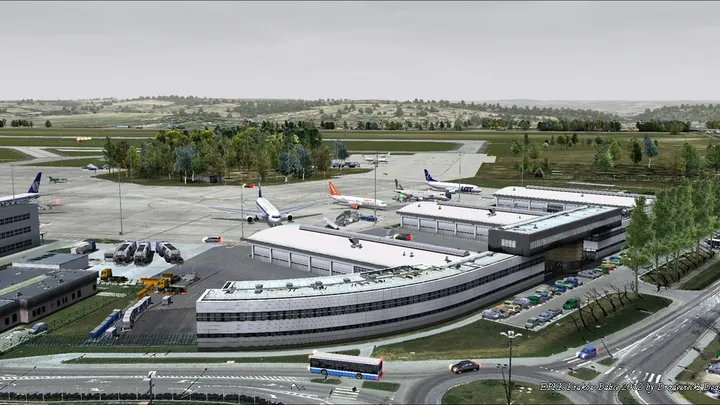
The control tower and terminal observation deck have modelled interiors. Airport buildings, aircraft, trees and people use custom artwork.
Seasonal aerial imagery, city landmarks and terrain extend across Kraków. Snow covers roofs in winter.
Custom PDF charts and a manual accompany the scenery, which supports Aerosoft AES.


The free FS2004 collection includes this edition and five other Polish scenery releases. See what is included.
Designed for Microsoft Flight Simulator 2004 (FS9). Works with Ultimate Terrain Eastern Europe and VFR Poland.
Extract the desired scenery installers from the free collection. Remove previous versions and duplicate airport layout files (AFCADs), then run the installer. It adds the scenery to the FS2004 Scenery Library. Run it again to change optional features.
Customer support has ended for this edition. No further updates will be released.
Kraków John Paul II International Airport (EPKK) is at Balice, about eleven kilometres west of central Kraków. The civilian terminal and military facilities share one airfield. The surroundings change quickly on the way into the city, from wooded ridges and villages near Balice to the Vistula, Wawel Hill and the closely packed streets of the historic centre.
Kraków’s first major airfield was on the other side of the city at Rakowice–Czyżyny. Established as a military field in 1912, it later handled passenger services. As the city expanded around it, civil flying moved west to Balice in 1964. A surviving section of the old runway and the aircraft collections of the Polish Aviation Museum mark the earlier site.
Balice developed from a military installation into the principal passenger gateway to Lesser Poland. Successive terminals, larger aprons and the rail connection to Kraków changed the civilian side of the field. The continuing military presence accounts for the separate groups of hangars visible around a runway shared by passenger jets and transport aircraft.


